One of the most common of medications has a long and varied history. Some facts and history about Aspirin:
The Father of modern Medicine, Hippocrates, wrote about pain killers in the 5th century B.C.E. and mentioned a powder and tea made from the bark and leaves of the white willow tree that worked for headaches, pain and fever.
In 1829 scientists discovered that it was the compound called salicin in the willow and other plants that worked on headache, fever and pain.
Salicin was further chemically reduced to obtain pure salicylic acid, the actual substance that worked on pain and fever.
Pure salicylic acid was very hard on the stomach, so further research to combine it with another substance to make it more tolerable for the stomach lead to the production of acetylsalicylic acid.
In 1899 Felix Hoffman, a German chemist that worked for the German dye and drug manufacturer Bayer found out that acetylsalicylic acid helped his father's arthritis pain. He persuaded the company to manufacture the drug and it was patented in 1900. The compound was given the name Aspirin - "A" from acetyl, "spir" from the spirea plant from which salicin was extracted, "in" was a common ending for drug names.
Aspirin in powder form was distributed to physicians and soon became the number one drug in the world.
By 1915 Aspirin was manufactured in tablet form and could be bought without a prescription.
At one time the Bayer company held the trademark rights to both Aspirin and Heroin (before it became illegal)
Aspirin's reputation as a pain and fever reducer was increased during the world-wide Spanish Flu epidemic of 1918-1919.
In 1948 a general practitioner in California noticed that patients that he prescribed aspirin had a reduced incidence of heart attacks. He started to recommend taking aspirin for heart health.
In 1952 children's chewable aspirin was introduced.
Aspirin's popularity waned in the early 1950's after the introduction of acetaminophen and ibuprofen.
In the early 1970's, scientists discovered that aspirin inhibits the production of inflammation-causing chemicals called prostaglandins in the body, thus reducing pain.
When research showed that daily aspirin therapy helped prevent at-risk patients from having heart attacks, strokes and recurring heart attacks, aspirin sales increased.
Today more than 70 million pounds of aspirin are produced world wide per year, which makes it the most used drug in the world.
There are no major European or United States manufacturers of generic aspirin. Even the mainstay brand Bayer aspirin is made in Spain . China is the world's largest producer of aspirin.
The history of Silly Putty goes back to 1940 after the Japanese invaded the rubber-producing countries of the Far East and cut off the supply to the United States. With the subsequent hampering of war production, especially for tires, gas masks, rafts and boots, the government asked American industry to develop a synthetic rubber.
Here's where the story gets controversial, for there was more than one person who claimed the discovery of Silly Putty. Researchers for Dow Corning Company and General Electric Company both claimed discovery. The present manufacturer of Silly Putty, Crayola LLC, gives the credit to James Wright, a Scottish inventor that worked for General Electric in New Haven Connecticut in 1943.
The first Silly Putty was the result of the mixing of boric acid and silicone oil. Wright found that the material would stretch if slowly pulled, but break if pulled rapidly. Rolled into a ball it would bounce, would not mold and had a high melting point. Despite these properties, Wright determined the substance was not suited for use as a rubber substitute and he sent samples to other scientists that came to the same conclusion.
The story goes that some of the substance was obtained by an owner of a toy store, Ruth Fallgatter. She hired a marketing consultant, Peter Hodgson to market the bouncing putty and put it in her catalog. It out sold everything else in the catalog except for Crayola crayons, but Fallgetter did not continue to sell it. Hodgson saw its potential, and bought $147 worth of the substance. He named it Silly Putty, packed 1 ounce portions in plastic eggs that sold for a dollar each, and sold 250,000 of them in three days. But the new business almost went under in 1951 with the start of the Korean War, as silicone, a primary ingredient of Silly Putty, was rationed.
After the war, production resumed. It was originally marketed as an adult item, but by 1955 children became the primary customers. The first advertisement for Silly Putty was produced by Hodgson in 1957 and premiered on The Howdy Doody Show.
In1961 Silly Putty went world wide and became a hit in Europe and The Soviet Union. By the time Hodgson died in 1976, over 300 million eggs of Silly Putty had been sold and his business was worth $140 million, making it one of the most successful toys of the 20th Century. The following year Binney and Smith, the makers of Crayola crayons, bought the rights to it. By 1987, production of Silly Putty was in excess of 2 million eggs annually. So while the name may be 'silly', the profits generated by this toy that was created by accident certainly aren't!
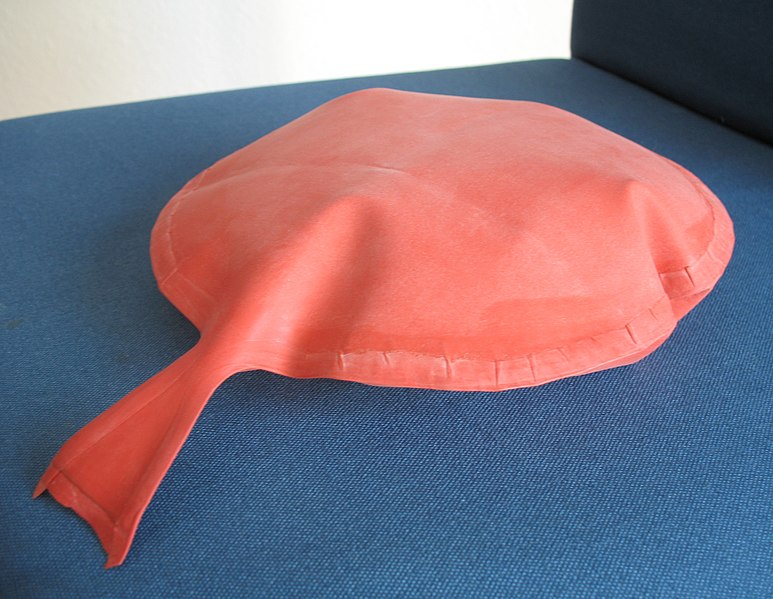
Consider the whoopee cushion, also referred to as the Poo Poo Cushion and Razzbery Cushion. An object of disgust for some, merriment for others. Invented around 1950 by two employees of the Jem Rubber Company of Toronto Canada, goofing around with scrap pieces of rubber sheeting. Sounds like it was a fun place to work. The company tried to sell the new device to Sam Adams, founder of the S.S.Adams Novelty Company. But Sam Adams refused, saying the item was too vulgar and would never sell. But other companies that Jem Rubber approached did not think the same way. The rest is history.
So what is the mystique of the whoopee cushion? Flatulence has never been proper behavior in public, at least for many people. Things that are not proper are wide open to the imagination of folks with a sense of humor. Flatulence jokes are found in the plays of the 5th century BC playwright Aristophanes, in the writings of Homer, Geoffrey Chaucer in his Canterbury Tales, in the Arabic tales translated by Sir Richard Burton Tales of 1001 Nights, Benjamin Franklin and Mark Twain both included references to the fart in their writings. Famous company for such low brow humor, I'd say.
My first experience with a whoopee cushion was brought about by my Dad, one of the great practical jokesters and pranksters I ever knew. When us kids were called in to supper, we never knew what was in store. A dribble glass, a pile of rubber dog doo doo on our plates, soup spoons with clear plastic inserts that soup would roll off of, a telescopic fork that Dad would extend to swipe food off your plate, rubber vomit. And between meals was no different. Chinese Finger Traps , Joy Buzzers, cans of mixed nuts that when opened out shot a long snake. By the time us kids were old enough to leave home, we had pretty much seen it all, prankster wise anyway. Some of us had enough of the pranks when we were kids, some of us were hooked on them. I confess to being hooked on them.
There were primarily two companies that sold these types of pranks over the years. The aforementioned S.S. Adams,which began business in 1906, and Johnson Smith Company that began business in 1914. Both companies are now out of business, but some of S.S Adams novelty gags are still sold. Johnson Smith at one time published a 500+ page catalogue full of novelties and gags in the 1920's, and my Dad used to order things from his childhood days until a few years before his death in 1993. Some comments from the Johnson Smith Company:
"Our story is not without sociological aspects and influences. During the 1920s and 1930s, practical jokes and home hobbies provided an escape for people wracked with economic struggle brought on by WWI and the Great Depression. Our catalog provided hours of "escape," fun and fantasy for the depressed nation, even without having to order! Even today we hear from people who remember our catalog and the "relief" we provided!"
So there you have it. Sociological aspects from pranks and jokes, including the whoopee cushion! There are also the technological aspects of this that should not be ignored. The original whoopee cushion, made from rubber and inexpensive, is still available, but the old technology has given way to the remote control whoopee cushion! While there is always a price to pay for technology, the modern version has 15 different sounds, can be operated with the remote control up to fifty feet away.
But there is still room for the original version of the whoopee cushion. It does take a certain degree of skill in use, and there are ways of getting different noises from the original whoopee cushion. For the purist, the original. For everyone else, the remote control version. Or if you're into record-setting, the giant Guinness World Record largest whoopie cushion:
So whether the results of using a whoopee cushion (either the vintage or new-fangled style) make you laugh, cringe, or turn away in disgust the whoopee cushion is here to stay. Whoopee Cushions
When did buttons begin to be used? What was used to secure clothing before them? Some history and facts about the button:
Button-like objects have been found in the Indus Valley of ancient Pakistan and date back to around 2000 B.C.E. These were not used for fasteners, but for ornaments. Before buttons were used for fastening, pins, leather lacing and belts were used to secure clothing.
Before buttons could be used as fasteners, the button hole had to be devised. Evidence dates the first button and button hole closure systems to the 13th century in Germany. This may have been a solution to the problem of how to secure clothing that was becoming more and more form-fitting, without having to resort to sharp pins.
As with most anything that is new, they became a fad. Buttons and button holes covered the clothing of the well to do. The number of them and what they were made out of became a status symbol. It has been rumored that King Louis XIV of France spent over $5 million on them in his lifetime.
Ever wonder why men's suit coats have non-functioning buttons sewn on the sleeves? Some say they are just for decoration, but there is also the story that King Frederick The Great of Prussia started the practice in the 18th century. The rumor goes that after an inspection of his troops, he ordered that buttons be sewn on the sleeves of their coats to discourage them from wiping their noses on them.
The Scovill Manufacturing Company in America made a set of gold buttons with the profile of George Washington on them that were presented to Marquis de Lafayette during his U.S. visit in 1824.
With the increased cost of ivory in the 19th century, button manufacturers began to make them out of a nut from a specific kind of palm tree in South America. This is called vegetable ivory, or corozo. When the nut is dried, it is a very reasonable facsimile for genuine ivory, and is still used today.
The first buttons made from celluloid, one of the first types of plastics, were made in the 1860's.
Before World War One, most button manufacturing was done in Europe, specifically England. After the war, the United States became the center of button making until modern times.
The invention of the wire clothes hanger has been attributed to Albert Parkhouse, an employee of Timberlake Wire And Novelty Company in 1903. This company fashioned wire lamp shade frames and other items from wire. One story goes that Parkhouse came to work one day, went to hang his coat up and found all of the coat hooks were in use. Out of frustration, Parkhouse grabbed a piece of wire, bent it into the shape of what we recognize as a clothes hanger on the spot. Another story says that Parkhouse was inspired by complaints from other employees of not enough coat hooks.
A patent for a clothes hanging device made from wire granted to John B. Timberlake, the owner of the company Parkhouse worked for, in 1904. It was common for the company to patent an employee's invention at that time. While it is not absolutely certain the Parkhouse was the inventor, it is for sure that the company and not the inventor profited from it. The wire clothes hanger became the preferred method of displaying clothing in shops when a men's clothing store in Grand Rapids Michigan was the first to display clothing on them in 1906.
But the idea for a clothes hanger did not start with Parkhouse or the Timberlake company. Some believe that Thomas Jefferson, the inveterate inventor of so many items also invented the first wooden clothes hanger. But all through the 18th and the first half of the 19th centuries clothing was usually hung on hooks or laid flat for storage. Hangers of various types and configurations began to be used in the middle of the 19th century. The prototype for the simple wire coat hanger began with a clothes hook that was patented in 1869 by O.A. North of Connecticut.
The basic wire coat hanger has changed very little from the original. There are also hangers made from wood, padded hangers, hangers with clips on the bottom to attach skirts or slacks. But the simple wire clothes hanger is not always used for hanging clothes. Because the type of wire used for them is relatively soft, it is easily bent, shaped and cut, wire clothes hangers have been a handy source of wire used by do-it-yourselfers, for children's arts and crafts, for lock picks and many other uses. The trend away from wire to plastic clothes hangers may be an inevitable step in the evolution of clothing storage, but what will multi-taskers do that use wire ones for more than hanging clothes on?
At the dawn of civilization, man discovered that characteristics of familiar base metals could be changed by combining them. In correct proportions, the metals compliment each other and form an alloy. Along with bronze, pewter was one of the first alloys known to humans. The earliest piece of pewter found is from an Egyptian tomb from 1450 BC.
Pewter is an alloy of primarily tin and copper, with other metals such as antimony, bismuth and lead. Pewter was known in ancient China, Egypt, Greece and Rome. The oldest known pewter item has been dated to 1500 B.C.E. and was found in Egypt. In ancient times it was an alloy of 70% tin and 30% lead, and this high concentration of lead caused lead poisoning when the alloy was used to make eating and drinking utensils. The lead would leach out, especially if acidic food or drink came in contact with the alloy. Modern pewter alloys no longer use lead in them due to lead poisoning dangers, and consist of tin, copper, bismuth or antimony. Pewter is a shiny metal, and has been called 'poor man's silver'. As it is highly malleable with a relatively low melting point (approximately 460 degrees F) it has been used for many items. Plates, drinking mugs, steins, flatware, candlesticks, and for jewelry. Due to the softness of the metal, pewter is not suitable for making tools.
The use of pewter had its roots in Europe about the 11th century. Pewter crafting in England grew especially skilled in the Middle Ages, and the metal's popularity continued until the late 19th century. Pewter craftsmen in the Middle Ages developed many different grades of pewter, of which three were:
Fine Grade had between 95 and 99 percent tin and 5 to 1 percent copper. This grade of pewter was very shiny, and was used to make eating and drinking utensils for nobility and the upper classes. Trifle Grade was usually 92 percent tin, 1 to 6 percent copper and up to 4 percent lead. It was also used to make eating and drinking utensils, but was not as shiny.
Lay Grade could contain up to 15 percent lead and was not used for eating or drinking utensils. It was used for candlesticks, basins, and other items. There are relatively few existing examples of early pewter ware because the metal was so easy to melt down into new items.
There has been a modern resurgence in the use of pewter. By casting, spinning on a lathe, pounding into shape and other means, pewter is used for a variety of items. The relative softness and low melting point of the metal lends it well to highly detailed figurines. Drinking steins are still being made that use pewter for the decorative lids, and jewelry of all types are cast from it. Given time, pewter will eventually oxidize and develop a satiny gray patina that can either be polished off or left on. 'Poor Man's Silver' remains a very useful and attractive alloy over 4,500 years since it was first discovered.
Thread is a tightly twisted strand of two or more ply of yarn used for hand and machine sewing. Some facts about sewing thread:
The difference between thread and yarn is that thread is used to sew together garments and other products, while yarn is a collection of fibers that is woven or knit into textiles. All threads are made from yarn, but yarn is not made of threads.
The first 'thread' to be used in sewing was made from animal sinew and plant fibers.
There are three types of thread, animal, plant and synthetic, based on the materials they are made from.
Silk is an example of thread made from animal products. The silk caterpillar weaves a cocoon made from silk that it produces. These cocoons are unraveled, and two or more strands are twisted together to form silk thread. Silk makes a very fine, stretchable and strong thread.
Cotton is an example of plant fibers used to make thread. Fibers of cotton are spun into a fine yarn; two or more strands of yarn are twisted together to make the thread. Cotton thread tends to shrink and is not as strong as silk thread. The thread is singed over an open flame and mercerized (dipped in a solution of caustic soda) to improve its strength and give it sheen.
Nylon and polyester thread are examples made from synthetic materials.
Ninety-five percent of all thread of all kinds manufactured are used in industrial and commercial sewing.
The development of the cotton thread industry in England was the result of a blockade during the Napoleonic Wars in the early 19th century. This prevented raw silk from entering the country, so no silk thread could be made for sewing. Patrick Clark invented a method for twisting cotton together to make sewing thread.
The original threads made by Clark were not strong enough to use in the new fangled sewing machines of the later 19th century. George Clark, a Grandson of Patrick, developed a six-stranded thread with the qualities necessary to be used in sewing machines.